Disclaimer: This article provides general information and is not legal or technical advice. For official guidelines on the safe and responsible use of AI, please refer to the Australian Government’s Guidance for AI Adoption →
How to Start a Startup and Use AI to Make It Easy (2026)
QUICK LOOK: BUILD FAST, PROVE IT, STAY TRUSTED
In 2026, speed matters, but trust is the multiplier. Use AI to compress busywork, then back your decisions with customer proof and clean operating habits.
What to do first
Write a painfully clear problem statement, then interview 12 real customers in 7 days. AI can help you prepare and summarise, but it cannot replace conversations.
What to measure
Ship the smallest measurable MVP. Track activation and retention, not vanity metrics. Run weekly experiments with a decision rule you follow.
How to use AI safely
Classify your data, keep sensitive info out of public tools, and treat every AI output as a draft. Add a 60-second verification habit to everything important.
What this playbook covers
You will get three things:
A 30-day plan to go from idea to a measurable MVP.
A 90-day validation system with weekly experiments and decision rules.
Responsible AI guardrails so you move fast without burning trust.
Free download
Founder validation kit Checklist & Notes
Capture your hypothesis, data sensitivity, risks, and weekly decisions in one place. Includes a one-page summary format you can share with mentors, advisors, and early customers.
Early-stage capital is still selective, and customers expect proof. AI can reduce time-to-learning by automating busywork like desk research, clustering feedback, and drafting experiments. The trade-off is that unmanaged AI use can introduce privacy risk, security risk, and confident inaccuracies. In 2026, the teams that win are the teams that move quickly with discipline.
💡Working rule
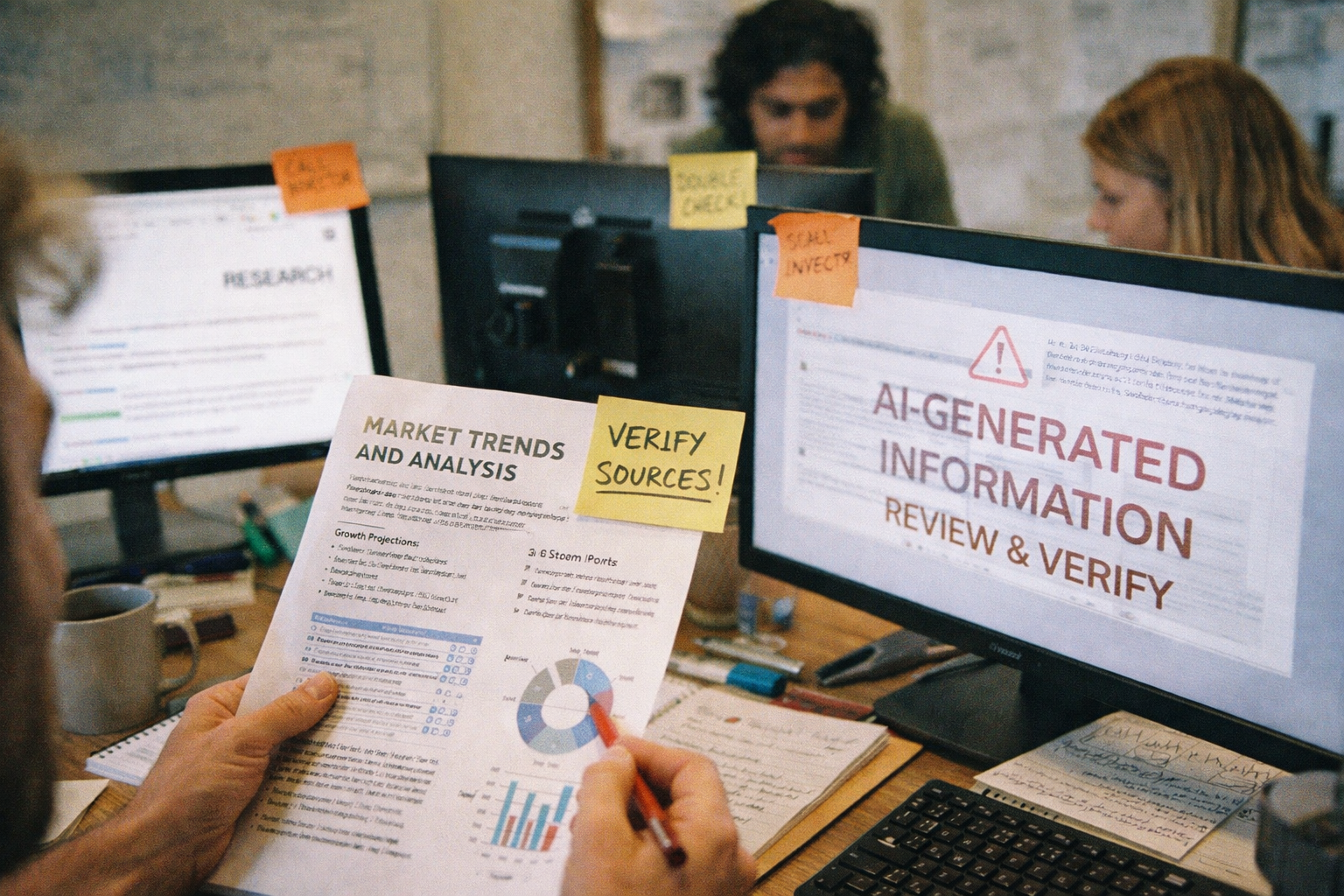
Every AI-assisted output is a draft. Pair it with a 60-second verification habit: check sources, sanity-check numbers, and confirm anything that could harm a customer if wrong.
The 30-day plan
This is what to do first, in order. Keep it simple. Keep it measurable.
Days 1–3: Pick a painfully clear problem
Write this sentence and make it real:
“We help[specific customer]do[job-to-be-done]by[approach],so they can[measurable outcome].”
AI helps: generate versions, list competitors, surface objections, draft a one-page problem brief.
You do: make it specific enough that a target customer nods, not politely smiles.
Days 4–10: Talk to 12 people
You are not validating your idea. You are validating pain, urgency, and willingness to change.
Target: 12 interviews in 7 days. If you are not slightly uncomfortable, you are moving too slowly.
Use this script:
“Walk me through the last time this problem happened.”
“What did it cost you (time, money, stress, risk)?”
“What have you tried already?”
“If I could fix it tomorrow, what would ‘better’ look like?”
“Who else is involved in deciding or paying?”
“Would you pay for it? How would you expect pricing to work?”
AI helps: cluster themes, pull out phrases customers use, draft follow-up questions.
You do: keep raw notes and quotes. If AI says something surprising, verify in the source.
Days 11–17: Test an offer before you build
Build a simple landing page and force a real next step: book a call, join a waitlist with detail, agree to a pilot. This is a distribution test, not a design project.
Success looks like: 3–5 real next steps from your target audience.
AI helps: write copy variants, generate offer angles, draft an objection-handling script.
Days 18–30: Build the smallest measurable MVP
Your MVP must do one core action end-to-end and capture learning signals. The goal is not “launch”. The goal is instrumented proof.
Must have: one core workflow, activation event, retention signal, and a rollback plan.
AI helps: onboarding copy, help docs, test cases, code suggestions (still review everything).
The 90-day validation system
After the first 30 days, you need a repeatable rhythm. Run weekly experiment cycles.
Every Monday: pick one experiment
Hypothesis: “We believe [customer] will [action] because [reason].”
Test: “We will [do X] to see if [metric] hits [threshold].”
Decision rule: “If we hit it, we double down. If not, we change [offer, audience, channel].”
If it is sensitive, do not paste it into public AI tools. Use de-identified examples, synthetic data, or a secured workflow.
2) Build a “draft + verify” habit
Every important output gets a quick check:
What sources back this?
What could be wrong?
What would harm a customer if this is wrong?
3) If your product makes significant decisions, plan for transparency
If you do anything like automated approvals, ranking, eligibility decisions, risk scoring, or pricing decisions, build explainability and documentation early. Even if you are small now, future customers and partners will expect you to explain what your system does, what data it uses, and what controls exist.
4) If kids might use your product, design for it early
If your product is even adjacent to children, choose stronger defaults, clearer language, and tighter data practices. You do not want to retrofit trust later.
AI workflows that actually help
Use AI to compress time. Use humans to confirm truth.
Workflow A: Research sprint in 90 minutes
AI generates: market map, competitor list, pricing models, objection list.
You verify: 10 key claims with primary sources.
Output: a one-page brief and 5 customer questions.
Workflow B: Customer feedback to product decisions
AI clusters: notes, transcripts, tickets into themes.
You decide: top 3 pains, top 1 build.
Output: experiment card and weekly changelog.
Workflow C: Build faster with guardrails
AI helps: code suggestions, tests, docs, edge cases.
You enforce: review, logging, rollback plan, privacy checks.
Output: an MVP that survives contact with reality.
Final checklist
If you do nothing else, do this:
One-sentence problem statement your target customer agrees with
12 interviews completed, with quotes and willingness-to-change evidence
Landing page offer test with real next steps
Smallest measurable MVP with activation + retention tracking
Data classification and a clear rule for sensitive information
Weekly experiment cadence and a decision log
Conclusion
In 2026, the teams that win are not the teams that “use AI the most”. They are the teams that learn fastest, measure honestly, and protect trust while they scale. Use AI to speed up the work, then earn your right to grow with evidence.
Your Next Steps
1Download the validation kit and start an experiment card for your first week.
2Book 12 interviews for next week. No building until you have dates in the calendar.
3Ship a measurable MVP in 30 days. Keep it small, keep it real, keep it instrumented.
About the Author
Dr Sam Donegan
Medical Doctor, AI Startup Founder & Lead Editor
Sam leads the MLAI editorial team, combining deep research in machine learning with practical guidance for Australian teams adopting AI responsibly.
AI-assisted drafting, human-edited and reviewed.
Frequently Asked Questions
Can AI write my business plan?
It can draft a strong baseline fast, but it cannot validate your assumptions. Use AI for structure, formatting, and first-pass research. Then verify with primary sources, real customer conversations, and your own numbers. Treat it like a junior analyst who works quickly and needs supervision.
What is the fastest way to validate a startup idea in 2026?
Run a 30-day sequence: write a one-sentence problem statement, interview 12 target customers, test a landing page offer, then ship the smallest measurable MVP. The goal is not to launch big. The goal is to learn with evidence.
How should I use AI in customer research without fooling myself?
Use AI to summarise and cluster your notes, not to invent customer truth. Keep raw notes and direct quotes. If an AI summary surprises you, go back to the source. Your rule is simple: AI can help you organise what people said, but it cannot replace talking to them.
Do I need to be technical to build an MVP now?
Less than ever. You can combine no-code workflows, templates, and AI coding support to ship something testable. The key is not the stack. The key is instrumented learning: activation, retention, and a clear decision log.
How much does it cost to build an AI MVP in Australia?
It depends on what you are building and how sensitive the data is. Many teams can get to a testable MVP on a few thousand dollars plus monthly tooling and hosting. If you handle personal or sensitive data, budget extra for better controls, security, and professional advice.
What are the biggest AI risks for early-stage startups?
Three repeat offenders: data leakage (pasting customer info into public tools), hallucinations (shipping confident nonsense), and trust gaps (no clarity on how your system makes decisions). Fix this with data classification, a verification habit, and simple governance you can explain in one minute.
.png?alt=media&token=dc0a3df1-837b-4549-be70-bc59ba215777)

.png?alt=media&token=70248355-2685-43f2-b855-57566e7146a7)
.png?alt=media&token=7893b797-dff8-43ed-a8d8-384e622884d1)